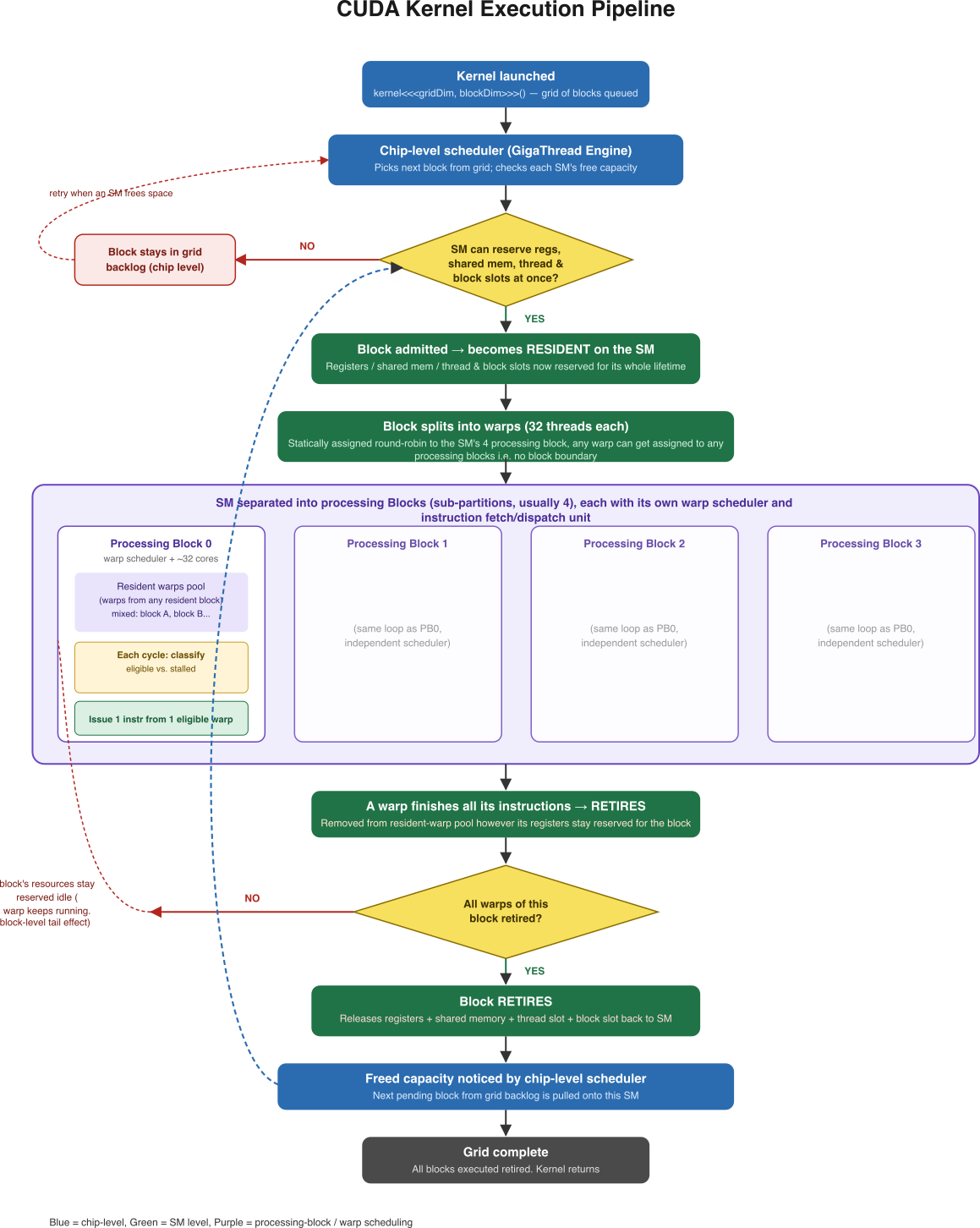
1. Kernel Launched
The CPU pushes a grid of threads into the GPU’s work queue by calling kernel<<<gridDim, blockDim>>>(...). The chip-level global scheduler (Nvidia calls it the GigaThread Engine) then distributes blocks to SMs based on each SM’s available capacity. This is a rolling assignment: as SMs free up space, they get handed the next block, so the whole grid doesn’t need to be planned out beforehand.
2. Resident/Active Warps
When an SM has enough free registers, shared memory, thread slots, and a free block slot, the global scheduler admits a block onto it, and the block becomes resident on that SM. The block is then split into warps (the actual unit of execution on a GPU), and each warp is assigned to one of the SM’s warp schedulers in a round robin fashion. These are now called resident warps.
3. Eligible/Stalled Warps
Each of the resident warps in the pool maintains a flag that classifies it as either eligible or stalled. Modern SMs typically have 4 warp schedulers, one per processing block (sub-partition) of the SM. Each cycle, a scheduler picks one eligible warp and issues its next instruction to its corresponding processing block. Since a processing block has a single instruction fetch/dispatch unit, all 32 threads in that warp execute the same instruction together, in lockstep. This is what gives a warp its SIMT execution model. A warp goes stalled when its next instruction depends on something long-latency like a memory fetch, a __syncthreads() barrier, or an unresolved data dependency. When the memory result comes back, that warp’s flag flips back to eligible at that moment.
4. Warp Retirement
When all of a warp’s instructions finish executing, it retires, so it’s removed from its scheduler’s schedulable pool and never gets picked again. Its registers and thread slots, however, are not freed at this point.
5. Block Retirement
Once every warp in a block has retired, the block itself retires, and only then, its resources - registers, shared memory, thread slot, and block slot are released back to the SM. This frees up space for another block from the grid, and the chip-level scheduler immediately tries to admit a new pending block into the space that just opened up.
6. Grid Complete
Once every block in the grid has been assigned, executed, and retired, the kernel call returns control to the host (CPU) asynchronously, unless the host explicitly synchronizes.